
If you have kids heading toward college, you've probably felt pulled in two directions. Save for their future, or protect your own. It's one of the most common tensions we hear from families, and it's worth talking about directly: you don't have to choose one over the other, but you do have to be intentional about how you handle both at the same time.
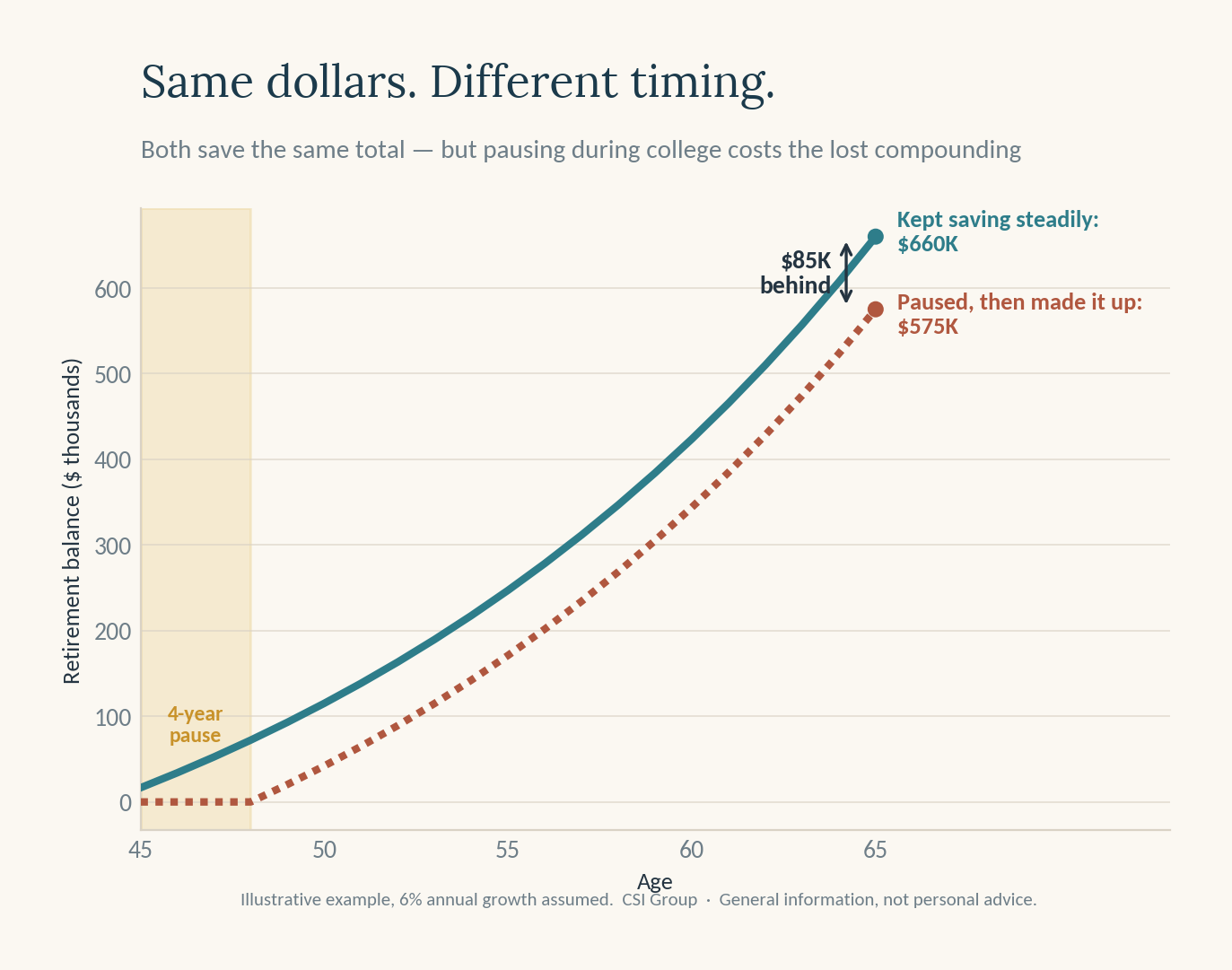
The biggest mistake we see is families pausing retirement contributions entirely to fund a 529 college savings plan. The thinking makes sense on the surface. College is expensive, the timeline feels urgent, and it feels like the responsible thing to do for your child. But here's what gets missed in that decision: retirement accounts have annual contribution limits. If you skip a year, that contribution opportunity is gone permanently. You cannot go back and make it up later. College funding, on the other hand, offers your child options that your retirement simply does not. Financial aid, merit scholarships, student loans, work-study programs, community college for the first two years. Your retirement has no equivalent safety net. No one is going to offer you a loan to fund your lifestyle at 75.
That doesn't mean college savings doesn't matter. It means you sequence things correctly. Keep contributing to your retirement, even if you need to reduce the amount for a season. Then direct what's left toward a 529. Even modest, consistent contributions to a 529 grow meaningfully over a ten-year window, and any growth used for qualified education expenses comes out completely tax-free. That combination of tax-deferred growth and tax-free withdrawal is one of the better deals available to families who start early enough.
One thing families often overlook is how account ownership affects financial aid eligibility. A 529 owned by a parent is treated more favorably under the FAFSA formula than a 529 owned by a grandparent. Custodial accounts like UGMAs or UTMAs are treated as student assets, which can reduce aid eligibility more significantly than a parent-owned 529 would. These distinctions are subtle, easy to miss, and can have a real dollar impact on what your family receives in aid. Getting the structure right from the beginning matters.
There's also the question of how much you actually want to fund. Some families aim to cover 100% of their child's college costs. Others plan to fund a meaningful portion and expect the child to contribute through work, loans, or merit aid. Neither approach is wrong. But the target matters because it shapes how aggressively you need to save, how long you have to do it, and how much flexibility you have if your retirement picture changes in the meantime. If you and your spouse haven't aligned on this number, that conversation is worth having before your child enters high school and the window starts closing.
Here's a framework we find useful - Think of it in three priorities
1st Priority
Retirement contributions, which should be protected as a non-negotiable, even if the amount changes temporarily.
2nd Priority
Your emergency fund and near-term cash needs, which should be stable before you direct money toward long-term savings.
3rd Priority
Everything else, including college savings, additional investments, and discretionary financial goals. College savings lives in that third priority, not the first.
The specific allocation across those priorities depends on your household income, your retirement timeline, how many children you're saving for, and what other financial goals are competing for the same dollars. A family in their early 40s with two kids, 10 and 13 years old, has a very different calculus than a family in their early 50s with one child heading to school in two years. There's no universal answer, but there is a right answer for your family, and it's worth figuring out with someone who can look at the whole picture.
One more thing worth mentioning: the Secure Act 2.0 changed the rules on unused 529 funds in a meaningful way. Starting in 2024, if your child doesn't use all of their 529 balance for education, up to $35,000 can be rolled into a Roth IRA for the beneficiary, subject to certain conditions. That change removes one of the biggest objections families used to have about overfunding a 529. The risk of saving too much for college and getting stuck with a stranded account is considerably smaller than it used to be.
We cover this in every CSI360™ because for families in this season of life, it's often the most pressing financial question on the table. College savings and retirement are not competing priorities when they're planned together. They become a problem when they're planned in isolation, or when one gets sacrificed for the other without thinking through the long-term consequences.

If you haven't looked at how your college savings and retirement contributions are working together, or if your kids are getting closer to college age and you're not sure whether you're on track, this summer is a good time to take a look. We'd rather have that conversation now than after decisions have already been made.